Creating a B2B podcast: the strategic guide for marketing managers
Creating a professional B2B podcast is high on the agenda of many marketing leaders these days, and for good reason. In a landscape where human connection and authority are the deciding factors, a podcast offers the unique opportunity to have in-depth conversations that resonate with your target group. However, those who still think that audio alone is sufficient today are missing the boat.
Why a business podcast is essential for B2B growth
The days when podcasts were a niche hobby are far behind us. For B2B companies, it has become one of the most effective means of content marketing. The purchasing process in the B2B sector is often long and complex; trust is the most important currency. A white paper or blog post can be informative, but a podcast lets the vote and it face see your organization.
When we talk about a Create a B2B podcast, we're talking about creating a platform for thought leadership. It enables your organization to:
- Claim authority: By diving deep into niche topics, you show that your company really controls the matter.
- Network expansion: A podcast is the perfect “excuse” for inviting CEOs, experts and potential customers for an hour-long conversation, something that would never work via a sales call.
- Content machine: One recording session provides content for weeks, provided you choose the right strategy (more about this later).
The indispensable role of video in modern podcasts
Let's get a big misunderstanding out of the way right away: a podcast is no longer “audio-only” these days. While audio platforms like Spotify and Apple Podcasts remain important to listeners on the go, the discovery of your podcast takes place elsewhere: on social media and YouTube.
Marketing managers who opt for audio only run into a wall of invisibility. After all, audio is not “shareable” on a timeline. People scroll past static images with an audio wave. Video is the carrier of emotion and attention. By choosing a video podcast, you create a format that is visually appealing. You see the non-verbal communication, the laughter, the frown and the chemistry between the speakers.
In addition, YouTube is now one of the largest search engines in the world for business content. If you're not there with an image, you're missing out on a huge range. One have a business podcast created therefore, by definition, means opting for a video-first approach.
The strategic advantage of outsourcing
The target group of this article (Marketing Managers and CEOs) has an agenda that is bursting. The idea of buying your own microphones, soundproofing a room, and spending hours assembling is often why plans end up on hold. In addition, the quality of “DIY” productions is often just not sufficient for the look you want as a high-end B2B brand.
Doing it yourself involves major risks:
- Technical complexity: Bad sound is the number one reason for listeners to drop out.
- Continuity: Without a fixed process, the frequency of publishing quickly dilutes.
- Professional appearance: A webcam conversation via Zoom does not exude the authority appropriate to enterprise-level services.
By working with a specialized party, you shift the focus of technique unto purport. Your job is to monitor the message and strategy; the technical realization, from lighting to color grading, lies with the experts.
Step 1: concept and format development
Before the cameras start running, the foundation must be in place. A successful one Create a B2B podcast starts with a sharp concept. What many companies go wrong is that they use the podcast as a disguised commercial. That is counterproductive.
Ask yourself the following questions:
- Who do we make this for? Be specific (e.g., “HR directors in healthcare” instead of “everyone”).
- What problem do we solve? Do we offer inspiration, tactical tips or insights into market trends?
- Who is the host? Is this the CEO, a product specialist, or are we hiring a professional moderator/host?
In this phase, a professional B2B podcast agency such as WYS Media helps you translate business goals into an exciting format. This includes fixed sections, the length of the episode and the tone of voice.
Step 2: Studio Experience and Recording
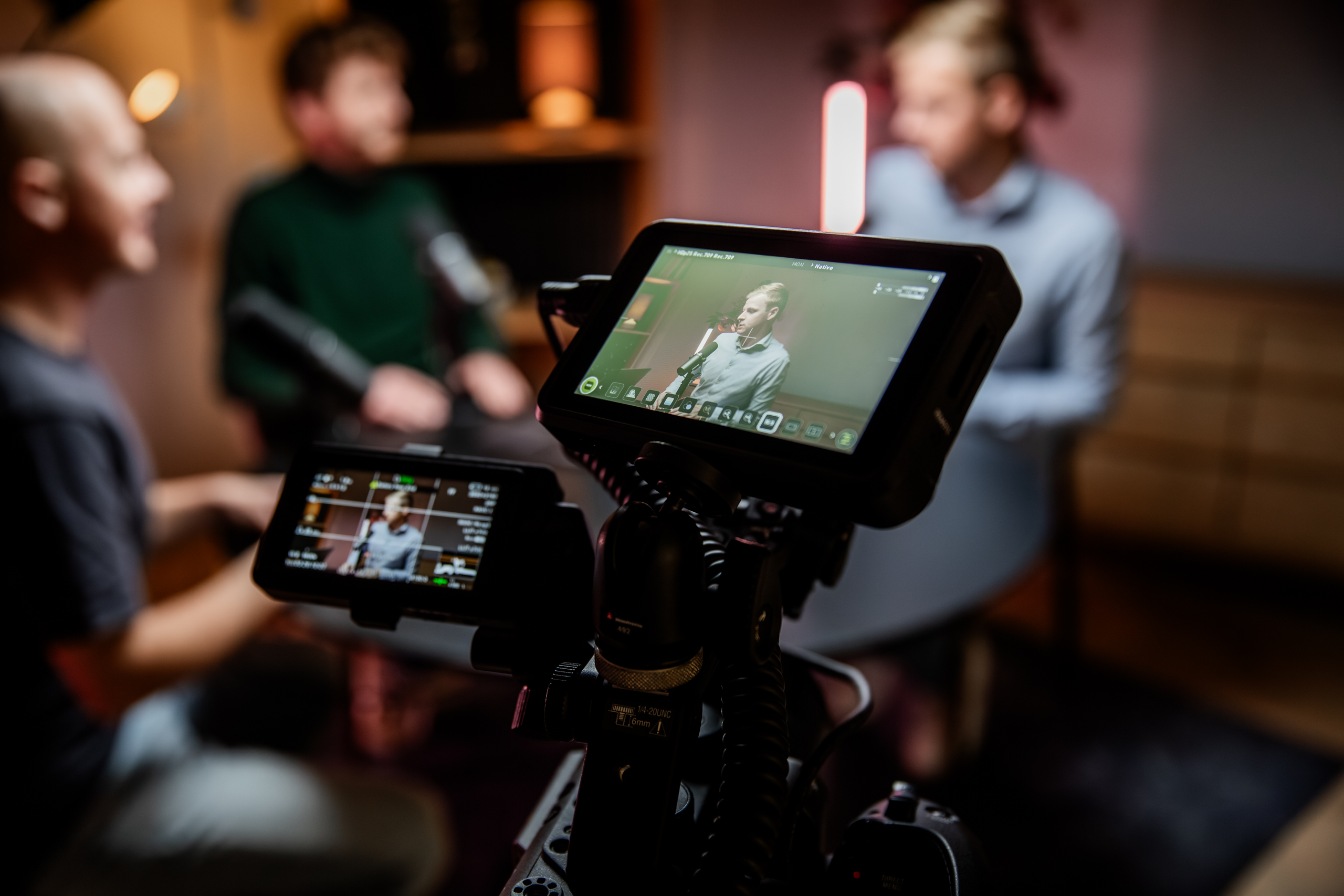
When the concept is in place, it is time for production. This is where the difference is made between amateurism and professionalism. In a high-end setting, such as a video podcast studio, nothing is left to chance.
A video podcast is all about the multicam setup. By working with multiple cameras (often three or four). This makes the video dynamic to watch, for example combination shots where two speakers with a cutout are in the picture together.
- Lighting: Cinema-quality lighting plans ensure that speakers look good and that the atmosphere matches the company's branding.
- Audio: High-quality microphones and acoustic treatment provide that typical, warm “radio voice” that listeners love.
- Direction: While you're having the conversation, an engineer monitors the recording, highlights interesting clips, and makes sure everything is technically flawless.
This comfort ensures that the host and guest can fully relax. There is no stress about technology, making the conversation more natural and in-depth.
Step 3: from long recording to snackable content
This is perhaps the most important part of the modern podcast strategy. You've recorded valuable content for one hour. What do you do with that then?
The raw material (the “pillar content”) is edited by video editors into a full episode for YouTube and Spotify. But it doesn't stop there. The real strength lies in repurposing. From one episode, a specialized agency can easily extract 5 to 10 short video snippets (shorts/reels) for LinkedIn, Instagram and TikTok.
.avif)
These short videos act as trailers. They draw attention to your target group's timeline and entice them to watch or listen to the full episode. But of course, you can also share all your knowledge on socials themselves. This is the only way to grow organically in the current age of algorithms. Without video, you simply don't have this ammo for your marketing channels.
Step 4: Distribution and Consistency
Creating a B2B podcast isn't a sprint, it's a marathon. Consistency is key to building an audience. When you outsource the production process, you can often record in “batches”. You book the studio for half a day, record two, three or four episodes in a row, and you immediately have content for the coming months.
The agency provides the files ready-to-use, even with blogs, snippets and accompanying captions, so that you get 20 ready-to-use content items per podcast.
Common mistakes to avoid
In our experience, we often see companies stumble across the same bumps when they underestimate the process:
- Being too commercial: No one listens to a 45-minute sales pitch voluntarily.
- Poor guest preparation: A guest must know what is expected, but the conversation must not be scripted. Spontaneity works best.
- Underestimating the “packaging”: A good podcast also needs a strong title, a catchy description, and a professional thumbnail. These are things that a video podcast agency includes in the delivery as standard.
Conclusion: invest in quality
As marketing manager or director, you are faced with the choice: do you go for quantity and speed with an in-house webcam solution, or do you opt for quality and impact? In the B2B world, where image and professionalism are directly linked to the perceived quality of your service, that choice is quickly made. A video podcast is a business card that works for you 24/7. It builds trust even before the first quote is sent.
Do you want to get serious and stay ahead of the competition? Then collaborating with experts is the logical next step.
Podcast FAQ
1. What does it cost to have a B2B business podcast created?
Costs vary depending on frequency, length and preferred means of distribution (such as social snippets). It's important not to see this as an hourly cost, but as the creation of a month's worth of content. Where you normally distribute budgets between copywriters and video ads, you now bundle this into one powerful medium. You can find the prices here.
2. Do we really need to use video, is audio not enough?
Yes, video is essential. Without video, you miss the ability to be effectively visible on LinkedIn and YouTube. Audio is for retention (retention), video is for acquisition (reaching new listeners). The combination is worth gold.
3. How much time does this take my marketing team?
When outsourcing to an agency such as WYS Media, the time investment is minimal. You focus on inviting guests and preparing the content. The technical structure, recording, editing and 'cutting' of social content is completely taken care of.
Quality makes the difference
The choice of production method directly determines the success of your podcast. Below you can see the contrast between doing it yourself and the professional approach.
Oude manier
Maximum visibility: Short, powerful video snippets provide reach on LinkedIn and YouTube.
TV-worthy quality: 4K cameras and professional lighting establish your brand as the market leader.
Complete care: You focus on the conversation, we arrange the technology and post-production.
Crystal clear sound: Studio acoustics and high-end microphones keep the listener engaged.
Nieuwe manier
Invisible on socials: Audio alone is difficult to share and doesn't grab attention on a timeline.
Amateurish look: Webcam images or poor lighting affect your brand authority.
Time-consuming: Spend hours cutting, pasting and resolving technical issues.
Poor audibility: Echoes and noise cause listeners to drop out quickly.
VS
Contact opnemen
Plan een kennismaking
Ontdek in 15 minuten hoe één podcast jouw marketing kan versnellen. Bouw autoriteit en word sneller de voorkeurskeuze.
Een goed gesprek over jouw wensen.
Weet gelijk wat alle mogelijkheden zijn.
Steel al onze content creatie inzichten.
Show don't tell
Wat klanten over ons zeggen.
Elke klantcase begint met experts die hun kennis delen. Wij vertalen die gesprekken naar krachtige podcasts en een stroom aan content. Zo ontstaan verhalen die vertrouwen wekken en impact maken op de doelgroep.
Van lege ruimte naar contentmachine en masterclass
Een kale vergaderzaal werd in enkele uren omgetoverd tot een volwaardige podcaststudio: de basis voor een constante stroom aan content én een inspirerende masterclass.
Berenschot claimt zijn expertstatus
Met de videopodcast Vooruitgang aan Tafel positioneert Berenschot zich zichtbaar als autoriteit en expert. En de opname is pas het begin: één podcast levert weken aan content op – van blogs en social posts tot video’s en nieuwsbrieven.
Huurders verleiden vanaf de bank
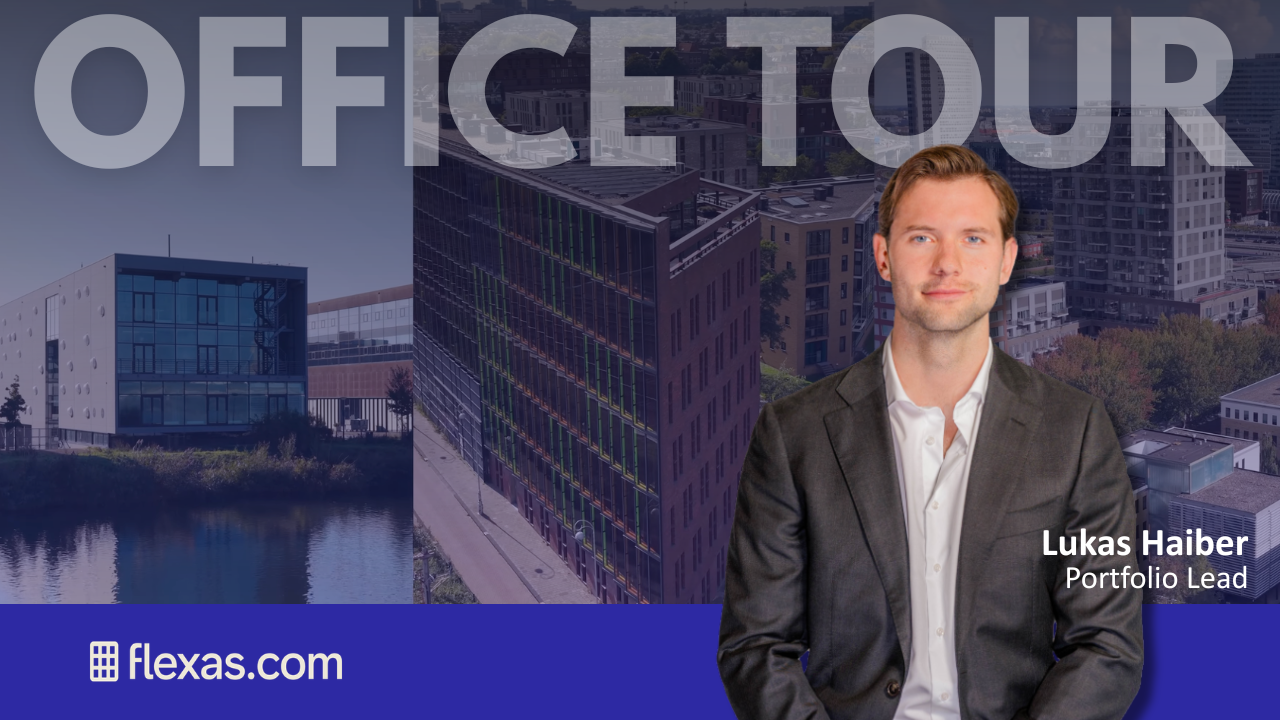
Voor Flexas, specialist in kantoorverhuur, maakten we rondleidingvideo’s die huurders vanaf de bank een realistisch beeld geven. Zo trekken ze de juiste huurders aan én besparen ze talloze nutteloze bezichtigingen.
Van klantverhaal naar investering
Voor Zonhub maakten we een videopodcast waarin ondernemers hun project en ambities delen. Door dit verhaal met de achterban te verspreiden, kregen investeerders direct vertrouwen – en volgden de eerste financieringen vrijwel meteen.